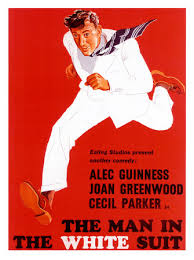
THE MAN IN THE WHITE SUIT
UK, 1951, 85 minutes, Black and white.
Alec Guinness, Joan Greenwood, Cecil Parker, Michael Gough, Ernest Thesiger, Howard Marion-Crawford?, Duncan Lamont.
Directed by Alexander Mackendrick.
The Man in the White Suit has a very strong reputation even after many decades. Nominated for an Oscar for best screenplay and for BAFTA awards for film and screenplay, it is one of the best films that came out of Ealing Studios. During the first half of the 50s Ealing was noted for its comedies with social comment including The Lavender Hill Mob, Passport to Pimlico, The Titfield Thunderbolt. Several of these starred Alec Guinness as well as many of the supporting cast including Joan Greenwood and Cecil Parker. (Guinness and Greenwood had appeared in the Ealing comedy masterpiece, Kind Hearts and Coronets.)
The film takes up the theme of post-war industrial Britain. Guinness portrays a naïve young man who invents a fibre that cannot be destroyed and cannot absorb dirt. This is seen as a boon for the public. However, the industrialists see disaster – as people will not be buying their products. They resort to dirty tactics – and the film has the spectacle of a white suit coming to pieces and dashing its inventor’s hopes.
Alec Guinness had been in films only for four years when this film was released. Appearing in David Lean’s Great Expectations and then as Fagin in his Oliver Twist, Guinness began to make a number of comedies at this time. By 1957, he won the Oscar for The Bridge Over the River Kwai.
The film was directed by Alexander Mackendrick, an American-born director who had great success in the United Kingdom with Whisky Galore, Mandy, The Maggie and The Ladykillers. Back in America he made The Sweet Smell of Success but had a very chequered career afterwards, his last film being the comedy Don’t Make Waves with Tony Curtis and Claudia Cardinale.
1. This is considered a classic British comedy of the fifties, Do you agree? How typical a comedy of the fifties is it? what are its major qualities?
2. Comment on the comedy qualities of the film, the situations, satire, dialogue, characterizations.
3. How did the film rely on an atmosphere of realism, even
though the film was satire? The initial and final commentary
by Cecil Parker? The presentation of the textile industry in the late forties in England? The comment about keeping the story out of the papers etc.?
4. How effective a satire on England was the film on its industry and finance, on capitalism and economics, on inventors, scientists, the workers and the unions, human greed? Where were each of these satirized effectively?
5. The comment on and the insight into the textile merchants and their deals, their budgets, their poor handling of their factories, their seeking for prestige, their trying to buy one another off etc.? What comment and judgement were made on them?
6. How were the workers and the unions presented? The feeling in the presentation of the workers, the satire on their behaviour? The fact that they united in their cause with the employers?
7. The initial presentation of the factory and its competence and incompetence? The use of the convention of the tour and the introduction of the film's themes?
8. The performance of Alec Guinness in the central role? The ordinary little man, his lodgings and friends, his genius, the quality of his experiments, his skill and his mistakes, single-mindedness, the humour of his explosions, the happiness of his success? The irony of success and its effect on him, with the employers, the workers, his girlfriend? The significance of his ultimate failure and everyone laughing at him?
9. How attractive was the heroine? Joan Greenwood's style, a conventional British heroine or more? Her support, her love, her going through the motions of seducing him and testing him? Her final support in his humiliation? The human feeling communicated here?
10. Such minor characters as the landlady and her washing? The people employed in the factories? The accounts people etc.?
11. How necessary was the failure of the cloth? How was England saved? The irony of being saved with the wrong methods and for the wrong reasons?
12. How did the black and white photography, the screenplay contribute to the film? The musical background# especially the symphony of the experiment?
13. What values were chiefly explored in this comedy? Was the film a good example of the British comedy genre?